Your existing engineering environment.
Repositories, coding CLIs, providers, deployment tools, people, product knowledge, architecture decisions, and release authority remain yours.
Coding agents can generate more work than your team can safely supervise. Buildfactory gives you the working machinery around that work: requirement repair, specification, test obligations, bounded workers, independent challenge, evidence, recovery, and acceptance.
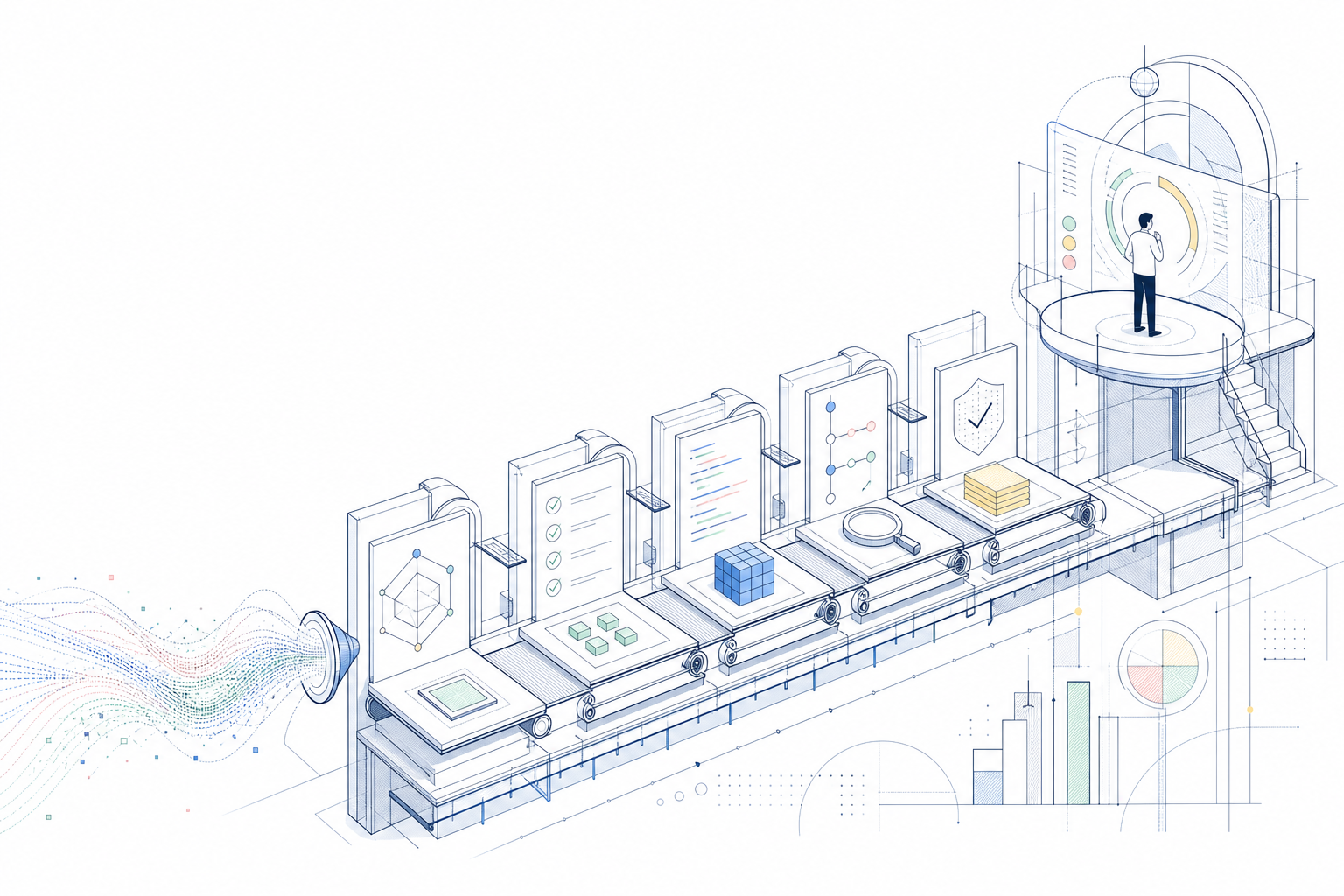
Every serious AI-assisted engineering team eventually needs workers, model routes, tests, review, evidence, recovery, sandboxes, state, authority boundaries, and a way to decide what has actually been completed. Those are not optional when generated work becomes part of a real delivery process. They become an internal platform project.
Repositories, coding CLIs, providers, deployment tools, people, product knowledge, architecture decisions, and release authority remain yours.
Buildfactory coordinates the AI step around your stack: it defines work, requires proof, routes failures, and retains the evidence needed to make a decision.
It does not replace engineering judgment, silently make a PoC production-ready, or convert a plausible completion narrative into proof.
Speed helps only when you can tell what was asked, what changed, what was proved, and what still needs your decision.
A PRD can sound clear until a worker tries to turn it into behaviour, interfaces, tests, and evidence. Missing decisions become silent assumptions, late rework, or scope drift.
Generated tests can be narrow, mocked, disconnected from the requested behaviour, or written after the implementation to agree with it. Test building needs its own obligation and review.
Producer, contract verifier, and truth-seeking inquisitor have different jobs. Conflating them makes a plausible answer too easy to accept.
When a provider fails, a prompt is malformed, or repair stops improving the result, you need to identify the cause, choose a route, or stop the work.
Without a working process, senior developers spend their time re-prompting, checking evidence, reconstructing context, and deciding whether to believe the system.
Generation is one station. The value is the line around it: a sequence of named obligations, evidence, checks, challenges, and repair routes.
Models produce plausible output. Engineering decides whether that output is specified, tested, integrated, evidenced, and acceptable for the work at hand.
Artifact structure, identity, repository state, required files, scope, and many gates can be checked mechanically before a model is asked to reason about them.
Review measures a result against defined obligations. Inquisition searches for weak proof, false confidence, hidden gaps, missing integration, and unsafe assumptions.
Worktrees, Docker, Proxmox, controlled scripts, and authority boundaries reduce cross-contamination and preserve an accountable run history.
A weak requirement, a bad test, a provider fault, stale evidence, and an implementation defect do not have the same fix. The system routes them differently.
The economic argument is not a fabricated ROI percentage. It is the avoided platform backlog and supervision burden of discovering every worker, gate, recovery route, and integration while also trying to ship your product.
Buildfactory gives you working machinery, then lets you retain the tools, processes, provider choices, human authority, and source-rights level that match your environment.
Bring a representative repository, product slice, or delivery problem. Use your own engineers or agents to challenge the machinery and decide whether it is the right starting point for your team.