Establish a serious starting point.
For solo developers, startups, and small product teams building their first maintained product.
- PoC and MVP Build Profiles
- Defined baseline-security scope for MVP
- No source; self-hosted operation
Buildfactory supplies the workers, process controls, evidence requirements, and recovery paths that teams otherwise discover while trying to ship their own product.
Not a generic agent canvas. Not a coding assistant. A practical operating base you install and adapt.
AI-assisted delivery creates another platform backlog: workers, managers, model routing, test controls, review, evidence, recovery, sandboxes, state, and provider fallbacks. Buildfactory gives you an advanced starting point, so your engineers can concentrate on the software that differentiates your business.
Workers, gates, artifacts, procedures, model profiles, and remediation routes are part of one delivery system—not a collection of ideas to assemble.
A Build Profile makes the intended evidence and the deliberate limits explicit. A PoC does not quietly claim production security; a higher-consequence profile demands more.
Keep your repositories, provider choices, sandboxes, human authority, engineering rules, and delivery tooling. Buildfactory coordinates the controlled work around them.
Every edition is a real working subset or extension of the same controlled-delivery approach. The difference is not a marketing checklist; it is the profiles, components, integration rights, source rights, and support needed for the job.
For solo developers, startups, and small product teams building their first maintained product.
For teams that need PoC, MVP, and SaaS profiles without taking on source ownership.
For companies standardising how AI-assisted delivery operates inside their engineering organization.
For organizations that need to inspect, modify, and extend Buildfactory internally.
A tailored design-partner engagement for high-consequence systems and environments.
For agencies operating Buildfactory across defined, isolated client delivery lines.
The controlled line begins by checking whether the PRD is buildable. It proceeds through specification, test, implementation, discovery, review, acceptance, and evidence. Findings return to the phase responsible for the cause.
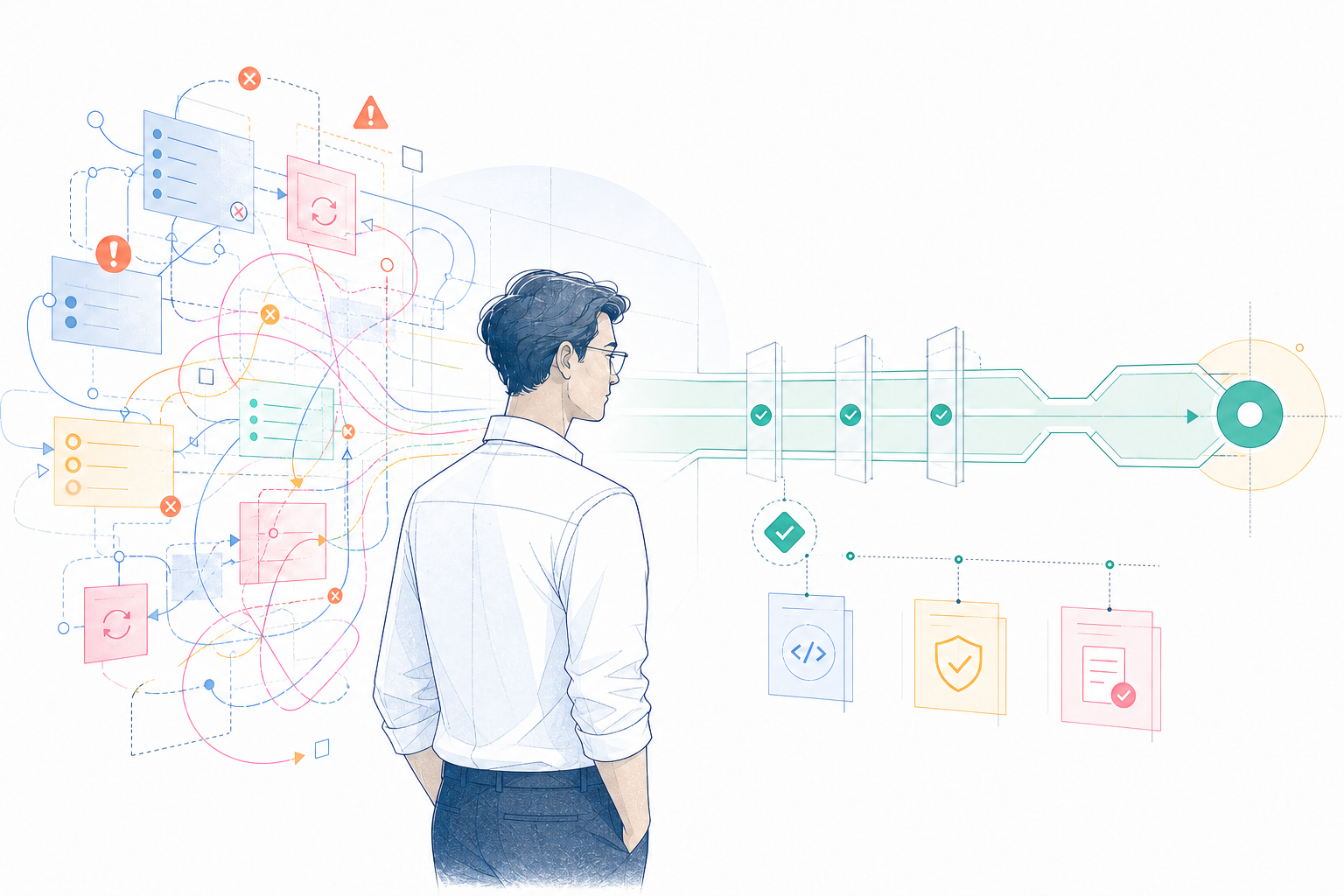
See the controlled process →AI can increase the volume of changes while moving work into constant supervision: re-prompting, checking claims, recovering lost context, finding gaps, and deciding whether the evidence is real. That work is mentally costly—and it can lengthen the day rather than giving it back.
The developer becomes the routing, recovery, and verification system—holding context together while agents retry, drift, or stop short.
Workers, gates, current evidence, and recovery paths handle routine supervision and surface bounded exceptions.
People stay responsible for intent, trade-offs, acceptance, and the decisions that actually need an accountable owner.
Map your current process, select the appropriate profile, run controlled work, and inspect the results with your own engineers or agents.